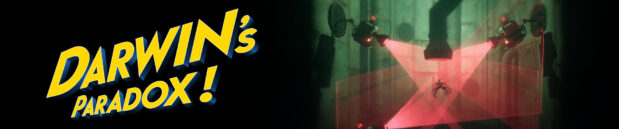
Thoughts on: Darwin’s Paradox!

Making cinematic platformers is hard. The “cinematic” part of it usually means that developers need to introduce enough variety and also fun unexpected twists and moments, while also somehow making sure that the pace of the game feels very tight, with no moments that would drag on. This also means that the best examples of the genre tend to be relatively short experiences, clocking under 4-5 hours if you do things well. Which makes sense – as with a good movie or a theater play, you wouldn’t sit through a longer runtime, it will simply start to get boring. Usually only puzzle-focused type of these games, or outright puzzle platformers, take longer to complete, since those games focus more on systemic puzzle solving, rather than an exciting adventure that keeps on moving. There are well known examples of the genre, from going back to its origins with Another World/Out of this World, to far more recent classics like INSIDE. And people seem to generally like the Little Nightmares titles, even though I find them a bit too boring. There are even some great but more “underground” examples like The MISSING: J.J. Macfield and the Island of Memories.

Darwin’s Paradox!, based on its initial showings and a demo, had a lot of promise. Octopus as the main character, who can stick to surfaces and shoot ink, in itself opened up a lot of possibilities for fun shenanigans, and the American 1950s pulp as the tone seemed really fun too. As I was playing the game’s initial sections I was occasionally frustrated, but always wanted to ignore those annoyances, because the game simply had too much charm. But as I kept playing, the game started dragging on, until by the end I was constantly on the verge of just dropping the game entirely. Which is a real shame.

Read more“Thoughts on: Darwin’s Paradox!”

Думки про: Darwin’s Paradox!

Створювати ігри в жанрі cinematic platformer складно. Бо “кінематографічність” означає, що в грі повинно бути достатньо різноманіття і сюрпризів, але також при цьому, гра повинна мати ідеальний темп і не застрягати на якомусь місці надовго. Через це, більшість прикладів жанру зазвичай займають не більше 4-5 часів на проходження. І це логічно, бо від фільму чи театральної постанови ви не очікували б довшого часу, інакше вам набридне це дивитись. Тож ігри, які займають більше часу або більше акцентують загадки, або повністю стають прикладами puzzle platformer жанру, бо люди тоді більше зацікавлені в системному вирішенні проблем, ніж в пригоді, яка постійно кудись рухається. Існує купа дуже відомих прикладів жанру, від класики типу Another World/Out of this World до сучасної класики типу INSIDE. Також людям подобалась серія Little Nightmares, хоча мені персонально перша гра здалась трохи нудною. Є навіть більш “культові” приклади, типу The MISSING: J.J. Macfield and the Island of Memories.

Після проходження демо версії, я очікував, що Darwin’s Paradox! мене приємно здивує. Восьминіг в ролі головного героя – цікава ідея, бо можна бризкати чорнилом та ходити по стінах. Та й тон гри, в стилі дешевої американської фантастики 1950-их про прибульців був цікавим. Тож, навіть коли деякі моменти на старті гри мене трохи дратували, мене це не сильно хвилювало, бо гра була занадто харизматичною. Але чим довше я грав, тем менше в мене залишалось терпіння. І під кінець проходження, я постійно думав про те, чи варто навіть продовжувати грати.

Read more“Думки про: Darwin’s Paradox!”

Disapprove: Assassin’s Creed Shadows (with Claws of Awaji)

I keep doing it to myself. I keep playing Assassin’s Creed games, long after most of the world dismissed them completely, in hopes that the series will finally find an identity and stick with it, instead of being the epitome of the “Ubisoft game”, as a dismissive description. I’ve played every game that was released on PC so far and the only two I have never finished were one of those uninteresting Chronicles games (I think the final one), and Valhalla, which was so horribly boring, I didn’t get much further than the opening act. Yet, if Valhalla was easily the worst Assassin’s Creed game so far that I didn’t finish, Assassin’s Creed Shadows is the one I wish I didn’t finish, instead of wasting almost 60 hours on it.

Read more“Disapprove: Assassin’s Creed Shadows (with Claws of Awaji)”

Розчарування: Assassin’s Creed Shadows (з Claws of Awaji)

Я продовжую над собою знущатись та проходити нові релізи Assassin’s Creed, тоді як весь світ вже давно їх ігнорує. І продовжую сподіватись, що колись ця серія зрозуміє чим вона хоче бути, і перестане бути просто “грою від Ubisoft”, в найгіршому сенсі. Я проходив всі ігри серії, які виходили на ПК, і не пройшов до кінця лише дві – одну з жахливих частин Chronicles (здається, останню), та Valhalla, від якої я просто засинав. Valhalla  – найгірша частина Assassin’s Creed, яку я не пройшов. Shadows – найгірша частина, яку я пройшов, але тепер думаю, що не варто було не витрачати на неї майже 60 годин.

Read more“Розчарування: Assassin’s Creed Shadows (з Claws of Awaji)”

Revisiting Assassin’s Creed Mirage with The Valley of Memory update

A year and a half ago I’ve enjoyed playing through Assassin’s Creed Mirage. It was a nice attempt by Ubisoft to remember what made the series what it was in the first place and while flawed, the attempt was a success and the game was easily among the best entries in the franchise. Heck, if you remember that the series are supposed to be a story-driven action stealth game in the urban environment, this might’ve been the best implementation of the idea yet, mechanically anyway.

And then, out of the blue, the studio has announced a free story expansion for the title called The Valley of Memory, that eventually released a few months ago. I wasn’t planning on revisiting the game so soon, if I’m honest, but I was in the middle of trying to force myself play through Assassin’s Creed Shadows, so I wanted to remind myself why do I even like these games. So I quickly played a few minutes of almost each title to remind myself of how they were, which culminated with me completing The Valley of Memory. Which renewed my opinion that Mirage is among the best entries. And that Assassin’s Creed really needs to figure out its own identity.

Read more“Revisiting Assassin’s Creed Mirage with The Valley of Memory update”

Повертаючись до Assassin’s Creed Mirage з оновленням The Valley of Memory

Півтора роки тому я з неочікуваним задоволенням пройшов Assassin’s Creed Mirage. Гра була дуже приємною спробою від Ubisoft повернутись до оригінальних ідей серії, і хоча проблем там все одно вистачало, гра була набагато кращою за більшість частин серії. Чисто з точки зору механік, це мабуть навіть найкраща реалізація всіх ідей, з яких починалась серія – тобто сюжетний екшен стелс з паркуром в місті.

Абсолютно неочікувано, студія заявила про вихід безкоштовного сюжетного доповнення для гри під назвою The Valley of Memory, яке вийшло пару місяців назад. І я не планував так швидко повертатись до гри, навіть заради доповнення, але я також в цей момент через силу проходив Assassin’s Creed Shadows тому хотілось пограти в частину серії, яка нагадала б мені, навіщо я взагалі в них граю. То ж я вирішив швиденько пробігтись по всій серії і потім пройти The Valley of Memory, що також підтвердило мої позитивні думки про Mirage. І те, що Assassin’s Creed не розуміє, що вона за серія.

Read more“Повертаючись до Assassin’s Creed Mirage з оновленням The Valley of Memory”

Thoughts on: ROUTINE

Now that I’ve played ROUTINE, after over a decade of waiting, I can safely say that the story of waiting for the game turned out to be far more interesting than the game itself. Announced back in 2012, the game looked very promising. It seemed like curious continuation of ideas from System Shock 2 and Doom 3, mixed with more modern (for the time) approaches made by Frictional Games with their Penumbra and Amnesia titles. But also mentioned some more unconventional concepts, like the idea of a permadeath or highly non-linearity… Then, development troubles ensued and after moving from Unreal Engine 3 to 4, then to 5 and changing quite a bit from those initial trailers, the game is finally out.

During the years of development, the craze for the Amnesia: The Dark Descent-like games have died out, as did the “scarecam” popularity of YouTube videos. In fact, streaming or recordings of streams seem to be far more popular for games nowadays than pre-recorded videos. A lot of the elements that people were hoping to see in Routine were realized to great effect in the fantastic Alien: Isolation back in 2014. And in 2017 Capcom revived the proper classic survival horror with Resident Evil 7, with the genre still being popular today. All of which would be hard to ignore going into Routine. But even if I did, even if I would imagine this game coming out in 2013 the same way it came out today, I’m not sure the game would’ve felt any less mediocre.

Read more“Thoughts on: ROUTINE”

Думки про: ROUTINE

Тепер, коли я нарешті пограв в ROUTINE після більше 10 років очікування, можу спокійно сказати, що цей час очікування виявився цікавішим за саму гру. Анонс проекту відбувся ще в далекому 2012-ому і проект виглядав як цікаве поєднання ідей System Shock 2 та Doom 3, але також з очевидним впливом ще свіжих на той момент проектів від Frictional Games типу Penumbra та Amnesia. В інтерв’ю розробники також розмовляли про цікаві і нетипові механіки та ідеї, типу смертей без можливості продовжити гру чи майже повної нелінійності проходження… Але після цього почались проблеми з розробкою, гра перейшла з Unreal Engine 3 на 4, а потім і на 5, і в процесі дуже сильно відрізняється від того, що показували в найперших трейлерах.

Також з часів анонсу популярність ігор, які схожі на Amnesia: The Dark Descent, впала, а відео де гравці лякаються на камеру вже майже ніхто не робить. Відео про ігри в цілому стало менш популярним ніж стрімінг. А купа речей, які люди очікували від Routine, були реалізовані в інших іграх, особливо в Alien: Isolation ще в 2014-ому. В 2017-ому Capcom повноцінно оживили жанр класичного survival horror з виходом Resident Evil 7 і саме цей жанр (знову) став найбільш популярним для копіювання. Все це неможливо ігнорувати, коли починаєш проходити Routine. Хоча… Навіть, якби я зміг, навіть якби ця гра вийшла в 2013-ому році, вона все одно би сприймалась як дуже посередня.

Read more“Думки про: ROUTINE”

In love with: Metal Gear Solid Δ: Snake Eater

Half a year ago I was revisiting the Metal Gear series with the Master Collection Vol. 1 that is now finally in a good state, and was pleasantly surprised by my experience with MGS3. Up until that playthrough, I had more respect for the entry than love and have far preferred the first and the second games. But the replay has shown Snake Eater in a new light to me, which was one of the main reasons I’ve decided to grab Metal Gear Solid Δ (Delta): Snake Eater. At the end of that previous review I wondered if Delta will be the better way to experience the game. And now I can definitively say – yes.

Read more“In love with: Metal Gear Solid Δ: Snake Eater”

Зачарований: Metal Gear Solid Δ: Snake Eater

Півроку назад я знову проходив частини серії Metal Gear в перевиданні Master Collection Vol. 1, яке на той момент нарешті оновили до достатньо робочої версії, і був дуже приємно здивований MGS3. До того проходження, я скоріше більше поважав цю частину, аніж любив і перша та друга мені подобались більше. Але тут я несподівано побачив Snake Eater новим поглядом, що й стало головною причиною для мене придбати Metal Gear Solid Δ (Delta): Snake Eater. В кінці мого огляду на перевидання оригінальної гри я задався питанням, чи не стане Delta кращою версією, щоб проходити гру. Тепер я маю відповідь – стане.

Read more“Зачарований: Metal Gear Solid Δ: Snake Eater”